


Everyday Ergonomics for Joint Health: Practical Steps and Whole‑Person Strategies to Keep You Moving
Healthy joints start with intentional movement and thoughtful environments. Ergonomics is simply the practice of matching tasks, tools, and posture to how the body moves so joints carry load safely and efficiently. This guide translates ergonomic principles into day‑to‑day habits, simple exercises, and lifestyle choices that lower joint stress, improve posture, and reduce repetitive strain. You’ll learn how to arrange work and home spaces, which micro‑exercises and strength work support joint mobility, how food and habits influence inflammation, and when to pursue clinical options if pain persists. We include clear posture cues, quick workstation checklists, and comparison tables of products, exercises, and regenerative therapies so you can pick what fits your needs. Where appropriate, we show how prevention and clinical care fit together—when conservative fixes aren’t enough, coordinated regenerative treatments plus a functional medicine approach can address root causes and improve outcomes. Consider this a hands‑on roadmap to protect knees, hips, wrists, shoulders, and spine while maintaining long‑term function.
What Is Ergonomics and Why Is It Vital for Joint Health?
Ergonomics means shaping tasks, tools, and spaces to match human anatomy and movement. That reduces excessive joint load and cumulative tissue wear. Small adjustments—raising a monitor, keeping wrists neutral, or providing proper seat support—lower contact forces and repetitive shear that speed degeneration. Research shows these simple changes can cut symptoms of repetitive strain and low‑back pain. Knowing the why helps you focus on the few daily tweaks that give the biggest joint‑protection return. Start with these immediate adjustments you can make today.
Ergonomics supports joint health by:
- Lowering joint compression and shear through neutral alignment.
- Reducing repetitive strain risk with correct tool and task positioning.
- Improving muscular support and cutting fatigue with better seating.
Those straightforward benefits lead into how posture works biomechanically to protect joint surfaces and reduce pain risk.
How Does Proper Posture Support Joint Function and Pain Prevention?
Good posture stacks bones so muscles and ligaments share loads evenly, which lowers focal pressure on cartilage and stabilizing tissues. A neutral spine preserves lumbar curves and decreases shear across discs and facet joints; shoulders and wrists in neutral positions avoid excessive compressive and tensile stresses. Practically, neutral alignment reduces peak contact forces on hips, knees, and wrists during common tasks—meaning less microtrauma and slower wear over time.
Try these three posture cues now:
- Stand with your ears aligned over your shoulders.
- Keep elbows near 90 degrees when typing.
- Sit with your hips slightly higher than your knees.
With neutral alignment in place, it’s easier to spot which daily activities place the most strain on your joints and how to modify them safely.
Which Daily Activities Most Impact Joint Health and How?
Certain habits load specific joints disproportionately—recognizing and adjusting them prevents cumulative injury. Long periods of sitting without lumbar support increase disc loading and hip stiffness. Lifting with a straight back increases shear at the lumbar spine and stresses the knees. Repeated hand tasks (typing, texting, gripping tools) keep the wrist in non‑neutral positions that compress tendons. Standing for long stretches without foot support increases knee strain and calf fatigue.
Reduce these risks by:
- Adding a lumbar roll or using an adjustable chair.
- Using a hip‑hinge and bending the knees when lifting.
- Alternating tasks to vary which joints bear the load.
- Choosing tools that keep wrists in neutral alignment.
These activity‑specific fixes segue naturally into practical workstation strategies for home and office.
How Can You Optimize Your Home and Office Ergonomics for Joint Protection?
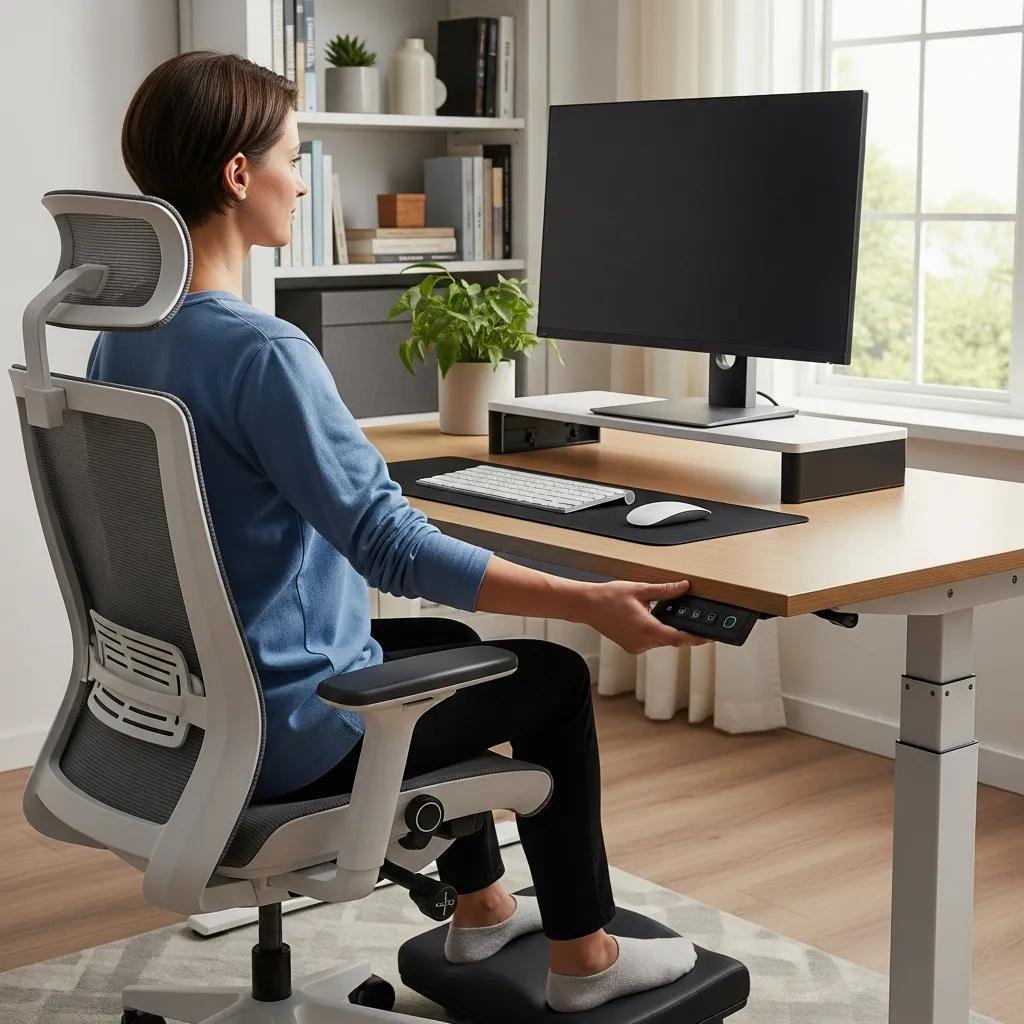
Optimizing ergonomics means aligning furniture and devices to lower joint loads, encourage movement, and prevent repetitive strain. Focus on monitor height, seat support, and peripheral placement so the body works efficiently throughout the day.
The principle is simple: correct geometry reduces joint moments and muscle overactivity that lead to pain. The payoff is more comfort, fewer flare‑ups, and better posture over time. Aim for the monitor top at eye level, elbows around 90 degrees, neutral wrists, and feet supported. Add regular standing or movement breaks to restore circulation and joint lubrication.
Use this checklist to create a joint‑friendly workstation:
- Monitor: Place the top of the screen at eye level, roughly an arm’s length away.
- Chair: Set seat height so hips sit slightly above knees and use lumbar support.
- Keyboard & Mouse: Keep wrists straight and forearms parallel to the floor; consider an ergonomic mouse if needed.
- Movement: Stand or move for 2–5 minutes every 30–60 minutes to reduce stiffness.
These setup steps will help guide product choices and whether a sit‑stand option fits your joints better than a fixed desk.
What Are the Best Ergonomic Workstation Setups to Reduce Joint Strain?
Top workstation setups prioritize correct body geometry and regular movement to lower joint contact forces and muscle fatigue. A sit‑stand arrangement lets you alternate posture and reduce static loading of hips and knees; a well‑adjusted seated setup with lumbar support preserves neutral spinal curves. Targets include 90‑degree elbow angles, monitor top at eye level, wrists neutral within about ±10 degrees, and forearm support when resting. Take movement breaks every 30–60 minutes with gentle spinal rotations, ankle pumps, and shoulder rolls to refresh joint lubrication. Choose sitting vs. sit‑stand based on your joint history and ability to transition safely.
Use the brief comparison below to match a setup to the joints you want to protect.
| Workstation Type | Key Feature | Joint Benefit |
|---|---|---|
| Traditional seated desk | Adjustable lumbar‑supported chair | Reduces lumbar shear and helps maintain a neutral pelvis |
| Sit‑stand desk | Height adjustability for standing breaks | Decreases static knee and hip loading; aids circulation |
| Laptop riser + external peripherals | Raises screen and allows use of neutral peripherals | Prevents forward head posture and excessive wrist extension |
| Compact standing mat | Cushioned surface for standing | Reduces knee and ankle discomfort during standing periods |
Pick the combination that addresses your most symptomatic joints and reassess periodically to keep comfort and function balanced.
Which Ergonomic Products Help Prevent Repetitive Strain Injuries?
Targeted ergonomic gear helps keep joints neutral and cuts down on repetitive microtrauma to tendons and cartilage. Prioritize chairs with adjustable lumbar support and armrests, keyboards that encourage a light touch and neutral wrists, vertical or trackball mice that reduce pronation, and footrests for better lower‑limb alignment. Investing wisely—starting with chair fit and peripheral ergonomics—usually gives the biggest joint‑protection return.
Product overview and joint benefits:
| Product Category | Feature to Look For | Joint Benefit |
|---|---|---|
| Ergonomic chair | Adjustable lumbar support, seat depth | Supports the lumbar spine and reduces low‑back strain |
| Split or low‑profile keyboard | Negative tilt or split layout | Helps maintain neutral wrists and lowers RSI risk |
| Ergonomic mouse | Vertical or contoured design | Reduces forearm pronation and wrist tendon load |
| Footrest | Height‑adjustable, angled | Optimizes knee angle and reduces thigh pressure |
Choose products that target your trouble spots for targeted relief and long‑term joint protection.
Next, build daily habits and exercises that increase joint resilience from the inside out.
What Daily Habits and Exercises Promote Healthy Joints and Posture?

Regular movement and targeted exercise preserve cartilage nutrition, strengthen supporting muscles, and reduce inflammation that fuels pain. Low‑impact cardio improves synovial fluid circulation; resistance training builds the periarticular muscles that share and buffer joint loads. Short mobility drills, postural micro‑exercises, and anti‑inflammatory nutrition reduce flare‑ups and slow degenerative changes. The sections below list specific exercises and dietary steps you can adapt to your mobility and pain levels.
Build a daily routine that blends mobility and strength:
- Micro‑movements: Short mobility sets every hour to avoid stiffness.
- Low‑impact cardio: 20–30 minutes of cycling, swimming, or brisk walking most days.
- Resistance work: 2–3 sessions per week targeting hip abductors, quads, hamstrings, and scapular stabilizers.
These habit pillars lead to specific exercises that boost joint mobility and durability.
Which Stretching and Strength Training Exercises Improve Joint Mobility?
A focused list of scalable exercises improves stability and range of motion while minimizing irritation. Hip bridges and clamshells strengthen hip abductors to unload knees; eccentric hamstring and quad work improves knee tracking and shock absorption; scapular retractions and wall angels restore shoulder mechanics and reduce rotator cuff strain; wrist extensor stretches and eccentric loading protect forearm tendons. Aim for short mobility sets daily and strength sessions 2–3 times weekly (2–4 sets of 8–15 reps), increasing resistance gradually. Safety note: avoid painful end‑range positions and prioritize slow, controlled technique—especially for people with chronic pain.
Exercise comparison for quick reference:
| Exercise | Target Joint / Muscle | Expected Benefit / Frequency |
|---|---|---|
| Hip bridge | Hips / glutes | Improves hip extension and unloads knees; 2–3x/week |
| Clamshell | Hip abductors | Boosts lateral hip stability; 2–3x/week |
| Eccentric squats | Knees / quads | Builds load tolerance and tendon resilience; 2x/week |
| Scapular retraction | Shoulders / scapula | Restores shoulder mechanics; daily micro‑sets |
With consistent exercise, dietary and inflammation control adds systemic support for joint tissues.
How Does an Anti-Inflammatory Diet Support Joint Health?
An anti‑inflammatory eating pattern lowers systemic signals that sensitize pain pathways and contribute to cartilage breakdown. Key mechanisms include omega‑3s influencing eicosanoid pathways, antioxidants from colorful vegetables and fruits, and steady blood sugar from whole grains and fiber to avoid pro‑inflammatory spikes. Practical choices emphasize fatty fish, walnuts, olive oil, leafy greens, berries, and legumes while limiting refined sugars, processed fats, and high‑glycemic foods. Staying well hydrated and maintaining adequate vitamin D and magnesium support tissue repair and muscle function. Nutrition is a core element of an integrated joint‑health plan.
Simple food guidance:
- Foods to include: fatty fish, leafy greens, berries, nuts, olive oil.
- Foods to limit: processed meats, refined sugars, trans fats.
These dietary steps help determine when conservative care is sufficient and when to consider clinical escalation.
When Is It Time to Seek Advanced Joint Care Beyond Ergonomics?
See a clinician when red flags suggest a persistent or structural problem that doesn’t improve with ergonomic changes and conservative care. Key indicators include ongoing pain despite consistent self‑care, progressive loss of function (trouble climbing stairs or standing from a chair), mechanical symptoms like catching or locking, or worsening night pain that affects sleep. Early recognition allows timely imaging, focused functional testing, and discussion of regenerative therapies that aim to reduce pain and restore function.
Watch for these red flags:
- Persistent pain despite conservative care for 6–12 weeks.
- Progressive functional decline that affects daily activities.
- Mechanical symptoms (locking, catching) or notable swelling.
What Are Regenerative Joint Therapies and How Do They Aid Chronic Pain?
Regenerative therapies use biological or physical approaches to calm inflammation, encourage tissue repair, and change pain signaling in chronic joint conditions. Examples include Platelet‑Rich Plasma (PRP), which delivers concentrated growth factors to support healing; Prolozone Therapy, which uses oxygen/ozone to enhance cellular metabolism; PEMF (pulsed electromagnetic field) therapy to influence cellular signaling; intra‑articular laser to modulate inflammation and microcirculation; and TruDOSE, a calibrated regenerative delivery system designed for consistency. These treatments are commonly used for moderate osteoarthritis, tendinopathies, and chronic degenerative pain when conservative care has been insufficient. Expect gradual improvement over weeks to months; the number of sessions varies by condition and response.
Quick comparison of common regenerative options:
| Therapy | Mechanism | Typical Indication / Expected Outcome |
|---|---|---|
| PRP (Platelet‑Rich Plasma) | Growth factor–mediated tissue signaling | Tendinopathy, mild–moderate OA; pain reduction over weeks |
| Prolozone Therapy | Oxygen/ozone metabolic modulation | Chronic joint pain and soft‑tissue healing; pain relief |
| PEMF | Cellular signaling with anti‑inflammatory effects | Pain modulation and improved tissue recovery |
| Intra‑articular Laser | Photobiomodulation of inflammatory pathways | Local inflammation reduction and better microcirculation |
| TruDOSE Regenerative Technology | Calibrated regenerative dosing | Standardized delivery aimed at consistent outcomes |
If you’re considering regenerative therapy, a coordinated functional assessment usually clarifies contributors and optimizes results.
How Does Functional Medicine Address Root Causes of Joint Issues?
Functional medicine looks beyond symptoms to identify systemic drivers—chronic inflammation, immune dysregulation, hormonal imbalances, nutrient gaps, and environmental exposures—that worsen joint problems and slow healing. It uses targeted testing (inflammatory markers, nutrient levels, gut‑health evaluation) and individualized interventions—anti‑inflammatory nutrition, tailored supplements, hormone optimization when appropriate, and lifestyle change—to treat drivers rather than just symptoms. Coordinating regenerative procedures with functional strategies improves the tissue environment for repair and can enhance the durability of outcomes by lowering systemic inflammatory burden. This integrated approach aims to restore physiological balance and resilience, not just mask pain.
Recognizing systemic contributors prepares you to combine ergonomic and clinical strategies into a sustainable care plan.
How Can You Integrate Ergonomic and Holistic Approaches for Long-Term Joint Wellness?
An integrated pathway sequences prevention, lifestyle change, ergonomic optimization, functional evaluation, and selective regenerative interventions to protect joint function over the long term. Start with practical workstation tweaks and daily micro‑exercises, progress to targeted mobility and strength work, add anti‑inflammatory nutrition and sleep hygiene, and consider regenerative therapies plus functional assessment if red‑flag criteria appear. Typical timelines move from immediate ergonomic relief (days to weeks) to measurable gains from exercise and nutrition (weeks to months) and potential regenerative benefits (weeks to months after treatment). Track pain and function scores to adjust the plan and decide when further evaluation or intervention is needed.
Stepwise checklist to implement an integrated plan:
- Immediate: Apply workstation and posture changes; begin daily micro‑mobility.
- Short‑term (2–12 weeks): Start progressive strength and aerobic conditioning; refine diet.
- If needed: Get a functional assessment and discuss regenerative options with a clinician.
Combining these strategies shows how ergonomics can amplify regenerative care—and how clinical treatments work best when mechanics and lifestyle are optimized.
What Joint Protection Strategies Combine Ergonomics with Regenerative Treatments?
Pairing mechanical fixes with regenerative therapies creates synergy: stabilize the joint with behavior and exercise while biologically supporting repair to increase the odds of lasting improvement. For example, a targeted hip‑strengthening program plus workstation changes to avoid prolonged knee flexion, combined with PRP for meniscal or early osteoarthritic changes, often yields better results than either approach alone. Likewise, correcting keyboard setup and doing tendon‑loading exercises before and after Prolozone or PEMF supports tendon remodeling and reduces re‑injury risk. Start with simple behavior changes, then time regenerative treatments to when joint mechanics are optimized for the best effect.
Paired strategies for common conditions:
- Knee OA: Hip and quad strengthening + PRP or TruDOSE as appropriate.
- Shoulder tendinopathy: Scapular stabilization + PEMF or intra‑articular laser adjunct.
- Chronic lateral epicondylitis: Ergonomic tool adjustments + Prolozone and eccentric loading.
These combined plans are most effective when individualized—talk with a clinician for a tailored assessment and treatment roadmap.
How Does Dr. Fred Bloem’s Personalized Care Enhance Joint Health Outcomes?
Internal Healing and Wellness MD, led by Dr. Fred Bloem, blends integrative and functional approaches with longer visits focused on uncovering root causes of chronic joint pain. Our care emphasizes individualized protocols that pair conservative care, lifestyle change, and targeted regenerative options.
We offer regenerative joint therapies including intra‑articular laser, PEMF, Platelet‑Rich Plasma, Prolozone Therapy, and TruDOSE Regenerative Technology, and we integrate these with functional medicine strategies to address systemic drivers of inflammation and impaired healing.
Our personalized model combines ergonomic coaching, exercise programs, nutrition guidance, and focused regenerative procedures to maximize recovery and lower recurrence. To schedule an evaluation or discuss a coordinated plan, contact Internal Healing and Wellness MD at (301) 260‑2601 or visit us at 10400 Connecticut Ave Ste 206, Kensington MD 20895‑3941. Appointments and follow‑up are tailored to your goals and clinical needs.
This invitation to consult ties prevention, lifestyle, and clinical options into a practical, individualized plan for lasting joint health.
Frequently Asked Questions
1. What are the signs that my ergonomic setup is not working for me?
Signs include ongoing discomfort, pain, or fatigue while working—common examples are neck or back pain, wrist strain, or frequent headaches. If you keep shifting position, feel stiff after sitting, or notice increased symptoms during or after work, your setup likely needs adjustment. Regularly reassessing your workstation and making targeted changes can improve comfort and productivity.
2. How often should I take breaks to maintain joint health while working?
Take short breaks every 30–60 minutes. Stand, stretch, or walk for 2–5 minutes to restore circulation and reduce stiffness. Adding quick micro‑movements or gentle mobility exercises during these breaks helps maintain joint range and lowers fatigue.
3. Can children benefit from ergonomic practices, and how should their workspaces be set up?
Absolutely. As children spend more time on screens, ergonomics helps prevent early postural habits that cause trouble later. Set screens at eye level, use chairs with lumbar support when possible, and ensure desks allow a 90‑degree elbow angle. Encourage regular breaks and movement to support healthy development.
4. What role does hydration play in joint health?
Hydration supports the viscosity of synovial fluid, which lubricates joints and reduces friction. It also helps deliver nutrients to joint tissues and clear metabolic waste. Dehydration can increase stiffness and discomfort, so drinking adequate water throughout the day is a simple but important habit.
5. How can I assess if my current exercise routine is beneficial for my joints?
Notice how your body feels during and after workouts. A joint‑friendly routine should improve strength, flexibility, and function without increasing pain or swelling. Track progress in mobility and daily tasks; persistent pain or swelling suggests you should consult a healthcare professional to adjust intensity, form, or exercise selection.
6. Are there specific ergonomic tools recommended for home use?
Yes—key items include an adjustable chair with lumbar support, a sit‑stand desk to alternate posture, and an ergonomic keyboard and mouse to keep wrists neutral. A footrest can help lower limb alignment. Start with the items that address your main complaints for the best return.
7. How can I integrate mindfulness into my ergonomic practices for better joint health?
Use mindful body checks throughout the day: pause to notice your posture, breathe deeply, and make small adjustments. Combine this with mindful stretches during breaks to reduce tension. Cultivating awareness of how you hold and move your body helps prevent strain and supports long‑term joint health.
Conclusion
Thoughtful ergonomics and whole‑person habits can make a measurable difference in joint comfort and long‑term function. By optimizing your workspace, committing to targeted movement and strength work, and choosing anti‑inflammatory nutrition, you can reduce pain and move more easily. If you’d like personalized support, explore our ergonomic recommendations and clinical care options—together we can build a practical plan that helps you protect and restore joint function for years to come.

